In 1885, Hermann Ebbinghaus sat alone in a room memorising nonsense syllables — DAX, BUP, ZOL — and then timed how quickly they slipped away. The curve he drew is still one of the most famous graphs in psychology: we lose most of what we learn within a day, and the rest fades more slowly after that.
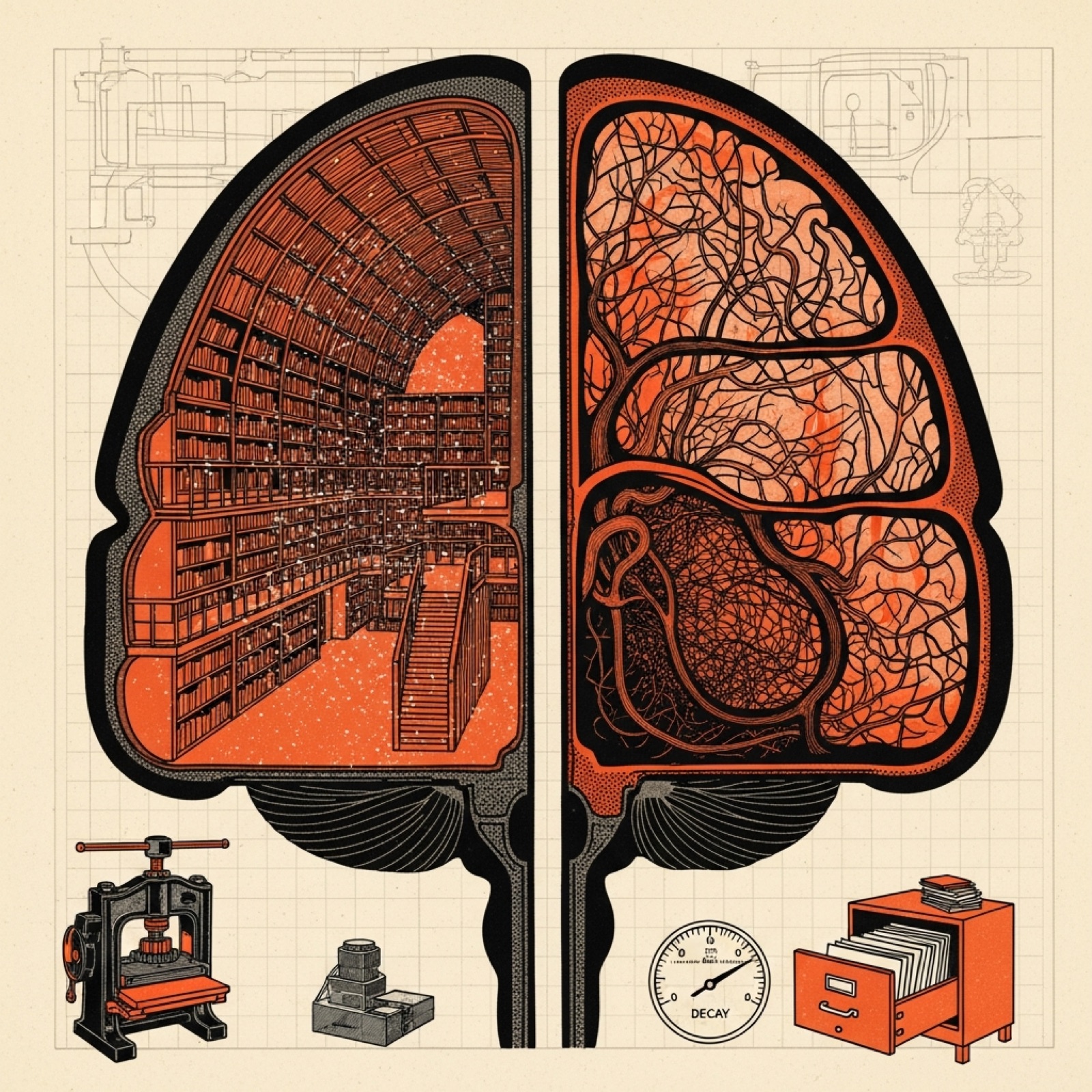
For a century, that curve was read as a story of loss. Memory was a vault, and forgetting was the leak. The newer view from neuroscience turns the story around.
Forgetting is active work
Your brain spends real energy erasing things. Specialised proteins prune synapses that are not being used. New neurons born in the hippocampus quietly overwrite old connections. During sleep, the brain replays some of the day's experiences and lets others dissolve.
None of this is an accident. A system that kept everything would drown in detail. To decide what to do next, you need the gist of the past, not a perfect recording of it.
A memory that never fades is a memory that can never generalise.
The cost of remembering everything
In the 1920s, the Russian neuropsychologist Alexander Luria began studying a journalist who seemed unable to forget. He could repeat long tables of numbers years later, in either direction. Yet he struggled with ordinary life. Faces were hard for him to recognise, because every new expression looked like a different person. Metaphors confused him, because he saw every word as a vivid, literal image.
His gift shows what forgetting does for the rest of us. Letting the details blur is how the mind finds the pattern underneath them.
Using it, not fighting it
If forgetting is the default, the useful question is not how to stop it but how to steer it. A few things reliably help:
- Spacing. Reviewing something just as you are about to forget it strengthens it more than cramming.
- Retrieval. Trying to recall an idea, even unsuccessfully, does more than re-reading it.
- Sleep. Much of the sorting between keep and discard happens overnight.
The brain is not a hard drive with a bad sector. It is an editor, constantly cutting. What survives the cut is what it has judged worth keeping — and you have more say in that judgement than you might think.