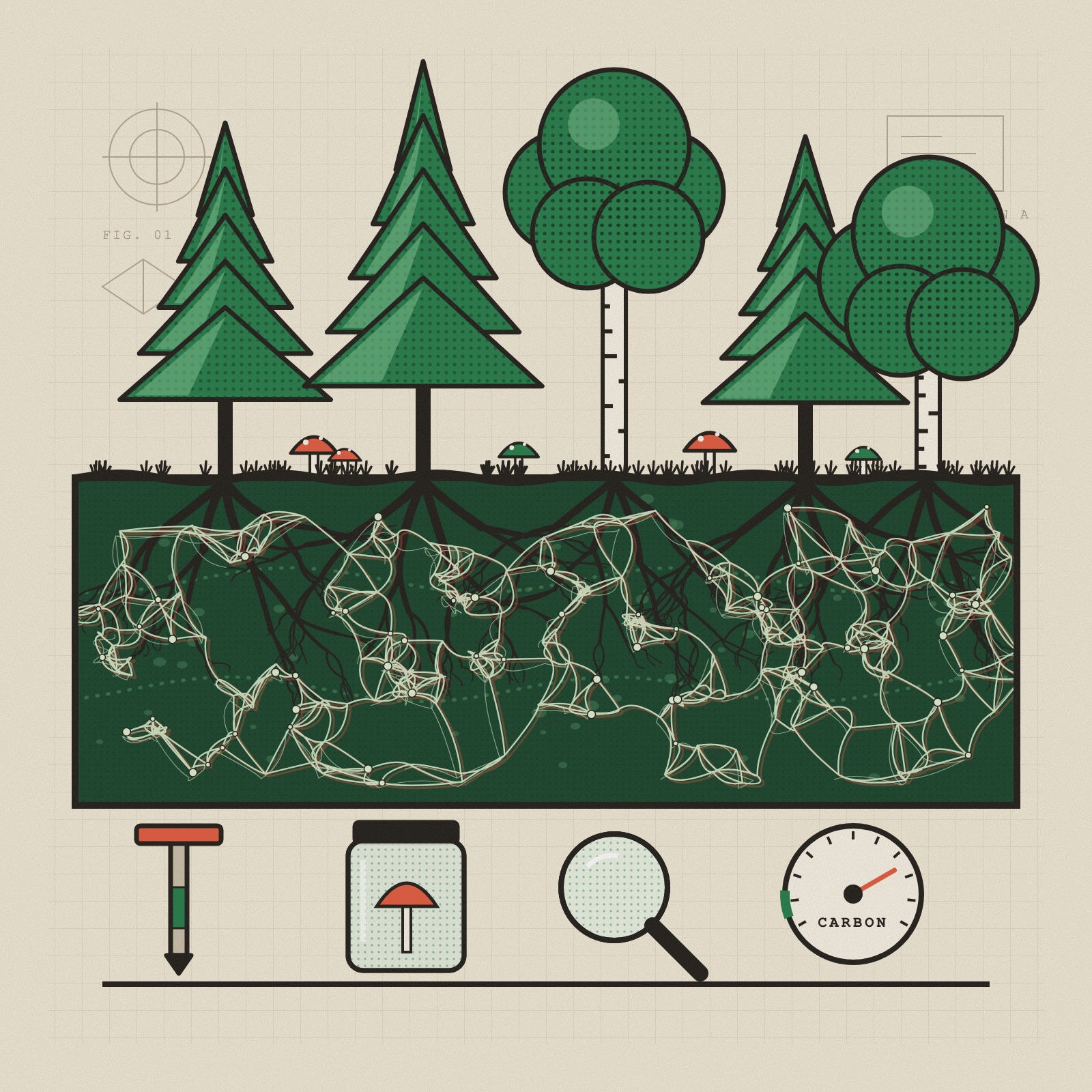
Walk through an old forest and you see individuals: a fir here, a birch there, each tree competing for light. Dig a few centimetres down and the picture changes. The roots are wrapped in fine white threads, finer than a human hair, running for kilometres through the soil. They belong to fungi, and they connect the forest into something closer to a single system.
A trade older than trees
These partnerships are called mycorrhizae, from the Greek for "fungus" and "root". Roughly nine in ten land plants form them. The deal is simple. The plant makes sugar through photosynthesis and pays some of it to the fungus. The fungus, whose threads reach far further than any root, gathers water, phosphorus and nitrogen from the soil and hands them back.
The arrangement is ancient. Fossils suggest fungi were helping the first plants colonise bare land more than 400 million years ago. In a sense, forests exist because of this partnership.
Most of a forest's life happens where we can't see it.
Sharing, or just plumbing?
In the 1990s, the forest ecologist Suzanne Simard ran experiments with tagged carbon and found it moving between neighbouring trees, apparently through shared fungal networks. The idea of a "wood wide web", in which older trees nourish seedlings and send warnings to their neighbours, spread quickly.
More recent reviews urge caution. Field studies show the networks exist and that resources can move through them, but how much, and whether trees are truly "helping" one another, is still debated. The fungi have their own interests, and what looks like generosity may simply be plumbing.
Why it matters
Whatever the final answer, the soil beneath a forest is not inert. It stores enormous amounts of carbon, much of it in fungal tissue. Clear-cutting and heavy fertiliser can break these networks apart, and they recover slowly.
- Healthy fungi help forests regrow after fire and logging.
- They lock carbon into the soil, sometimes for centuries.
- They are easy to destroy and hard to rebuild.
The next time you walk through a forest, it is worth remembering that you are standing on its most connected part.